
The Hungry Brain: Why Thinking Is So Expensive, and What Happens When Food Runs Low
Published:
Your brain weighs about as much as a small melon, yet it eats like a teenager. Even when you are sitting still and thinking about nothing in particular, it burns through energy at a rate that no other organ of its size comes close to. This single fact, that the brain is metabolically expensive, turns out to be one of the most important constraints in all of neuroscience. It shapes how neurons are built, how they signal, how we learn, and, as recent work suggests, how the brain rations its own performance when food becomes scarce.
This post walks through four ideas. Why the brain is so costly to run. Where exactly that energy goes. What it costs to learn. And a question that has only recently been answered with real data. Is there a low power mode of the neocortex in times of food scarcity?
Information processing in the brain is metabolically expensive
Let us start with the headline number. The adult human brain accounts for only about 2 percent of body mass, yet it consumes roughly 20 percent of the body’s energy at rest (Herculano-Houzel, 2011). In everyday terms, that is somewhere around 500 kilocalories a day, a fifth to a quarter of everything you eat, all spent on an organ you could hold in two hands.
To appreciate how lopsided this is, it helps to compare the brain to other organs. By mass, the brain is a minor player. Skeletal muscle and fat dominate the body. But when you look at resting energy expenditure rather than mass, the picture flips dramatically. The brain jumps from contributing under 2 percent of body mass to consuming on the order of 20 percent of resting energy, which puts it in the same metabolic league as the liver, heart, and kidneys despite being far smaller (Padamsey and Rochefort, 2023). Gram for gram, neural tissue is one of the most energy hungry tissues your body maintains.
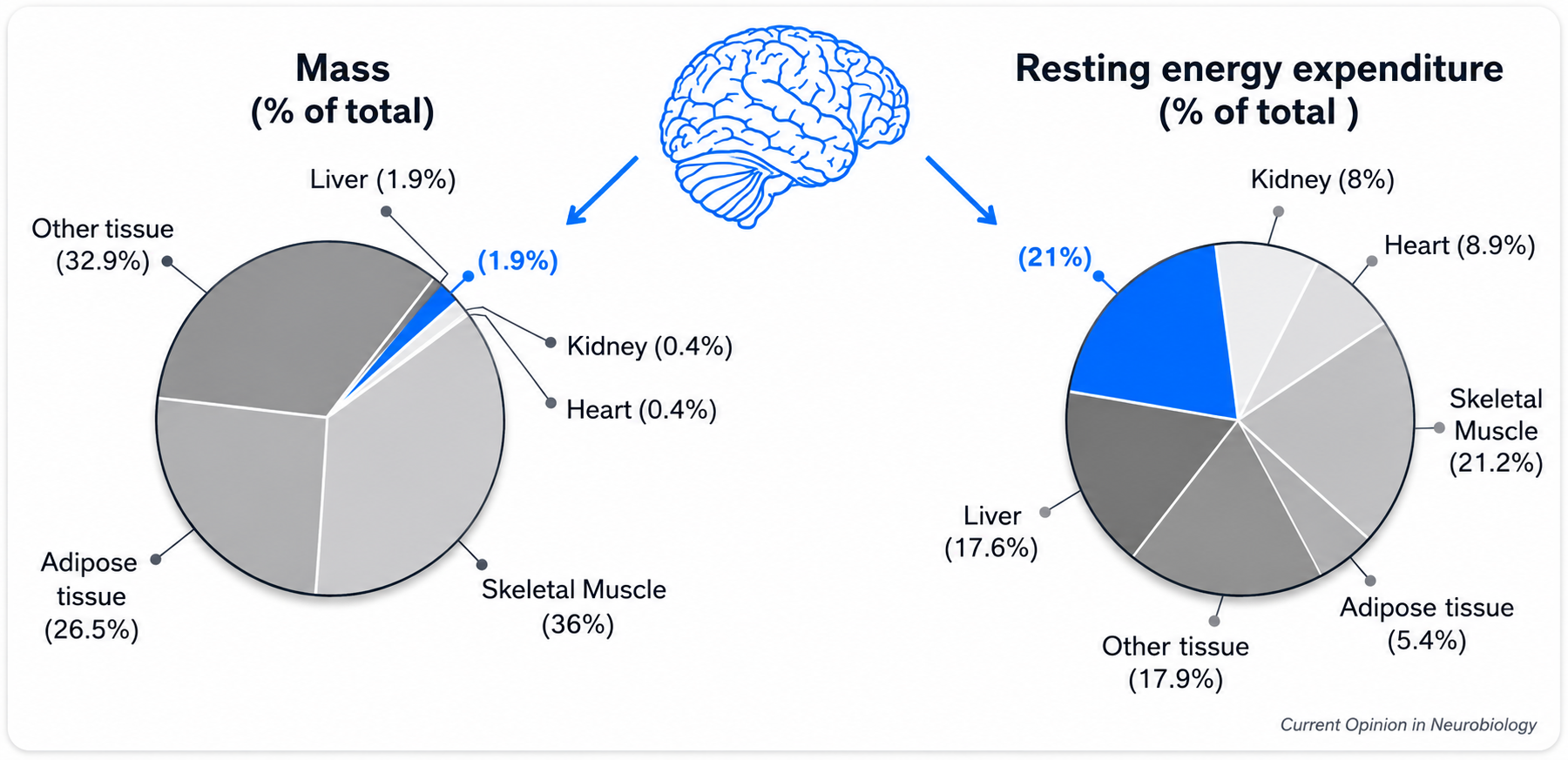
Fig. 1. The brain is a minor player by mass but a major one by energy use. Adapted from Padamsey & Rochefort (2023).
Why is the brain so costly? The short answer is that thinking is electrical work, and electrical work costs energy. Neurons constantly pump charged ions across their membranes to maintain the voltage differences they use to compute and communicate. Every signal a neuron sends, and every signal it receives, runs down those gradients, and the cell must then spend energy to pump them back up again. That energy comes in the form of a molecular fuel called ATP, short for adenosine triphosphate. The brain is, in effect, paying a continuous electricity bill just to stay ready to process information.
This is not a uniquely human extravagance. Across rodents and primates, the energy a brain uses scales in a remarkably orderly way with its number of neurons, so that each neuron costs roughly the same to run regardless of the size of the animal (Herculano-Houzel, 2011). The human brain is expensive not because our neurons are unusually greedy, but because we have so many of them. The bill is simply the sum of a vast number of small, fixed costs.
Where does all that energy go?
If the brain is spending a fifth of your calories, it is fair to ask what it is buying. Researchers have built detailed energy budgets that break down the cost of electrical signaling in the grey matter of the cortex, and the results are illuminating (Harris, Jolivet, and Attwell, 2012; Sengupta et al., 2010).
The single largest expense is synaptic transmission, the work of passing messages from one neuron to the next across the tiny gaps called synapses. This includes packaging the neurotransmitter, releasing it, and, on the receiving side, letting ions flow through receptors and then pumping them back out. By these estimates, synaptic transmission alone can account for well over half of the brain’s signaling energy budget (Harris, Jolivet, and Attwell, 2012). The next biggest cost is firing the action potentials themselves, the brief electrical spikes neurons use to communicate. After that comes the comparatively modest cost of simply keeping neurons and their supporting glial cells at their resting voltage, ready to act.
The lesson here is subtle but important. Most of the brain’s energy is not spent thinking a thought in some abstract sense. It is spent on the physical machinery of communication, the synapses. And because synapses are where learning happens, this fact connects directly to the cost of learning itself.
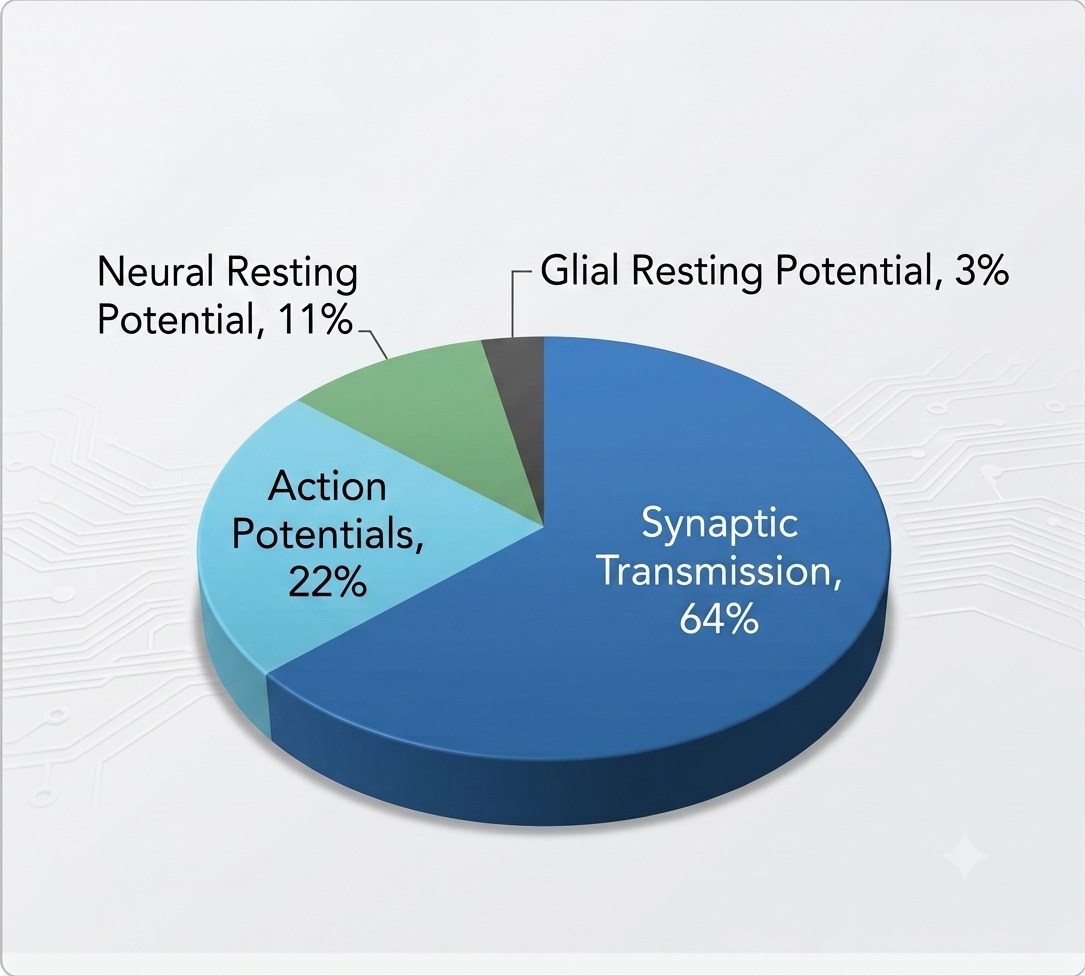
Fig. 2. Where the brain’s signaling energy goes. Adapted from Harris, Jolivet, & Attwell (2012).
The cost of learning
We tend to think of learning as effortless, or at least free. Biologically, it is anything but. Learning means changing synapses, strengthening some connections, weakening others, and sometimes building entirely new ones. Since synaptic transmission is already the brain’s biggest energy expense, anything that adds to the number or strength of synapses also adds to the running cost of the brain for as long as those memories are maintained.
The clearest evidence that memory carries a real metabolic price tag comes, perhaps surprisingly, from fruit flies. In an elegant experiment, Plaçais and Preat (2013) showed that forming durable, long term memories is so energetically costly that starving flies actively switch the process off. When the researchers forced hungry flies to form long term memories anyway, the flies died sooner. Their title says it plainly. To favor survival under food shortage, the brain disables costly memory. Memory, in other words, is a luxury the body will sacrifice when energy is on the line.
In humans, the cost of building a brain in the first place is staggering. Kuzawa and colleagues (2014) combined brain imaging and metabolic data to track how much energy the developing human brain uses across childhood. They found that brain glucose consumption peaks in early to mid childhood, at which point the brain is using glucose at a rate equivalent to roughly two thirds of the body’s resting metabolism. Strikingly, this peak coincides with the slowest period of childhood body growth. The interpretation is that the metabolic demands of wiring up a young, learning brain are so high that the body literally slows its own physical growth to pay for them. Learning, development, and energy are bound together from our earliest years.
So when we talk about the cost of learning, we are not being metaphorical. Every lasting memory is a small, ongoing draw on a limited energy budget, and evolution has clearly treated that cost as something worth managing carefully.
Is there a low power mode of the neocortex in times of food scarcity?
Here we arrive at the question at the heart of this post. We know the brain is expensive. We also know food is not always available. For most animals through most of history, calories have been volatile and unpredictable. So a natural question follows. When food runs low, can the cortex dial down its own energy use, the way a phone enters a battery saving mode? And if so, what does it cost in terms of performance?
For invertebrates, the answer was already suggestive (Plaçais and Preat, 2013). But the mammalian neocortex, the seat of perception and higher cognition, was a harder case to crack. That changed with a study by Padamsey and colleagues (2022), working in the visual cortex of mice.
Using detailed recordings from individual neurons and two photon imaging of cortical activity, they followed what happened when mice were food restricted until they lost about 15 percent of their body weight. The cortex did indeed shift into something very much like a low power mode. Neurons reduced the conductance of their excitatory AMPA receptors, which cut the ATP spent on synaptic currents by around 29 percent. Cleverly, the neurons kept firing at roughly normal rates by compensating in other ways, raising their input resistance and slightly depolarizing their resting voltage. From the outside, then, the cortex looked like it was working normally.
But the savings were not free. Running the synapses on a budget made the neurons’ responses noisier and less precise. The tuning of visual neurons, meaning how sharply they distinguish one line orientation from another, broadened by about 32 percent, and the animals became measurably worse at fine visual discrimination (Padamsey et al., 2022). In plain terms, the hungry cortex traded acuity for economy. It kept the lights on but turned down the resolution.
What links body fat to brain performance here is a hormone called leptin. Leptin is released by fat tissue and signals how much energy the body has in reserve, so when fat stores fall, leptin falls too. Padamsey and colleagues found that this drop in leptin was the trigger for the cortex’s energy saving changes. Remarkably, giving the food restricted mice supplemental leptin restored their coding precision (Padamsey et al., 2022). The brain, it seems, is listening to the body’s fuel gauge and adjusting its own performance accordingly. This is the work that earned the evocative description, in Quanta Magazine, of a brain low power mode that blunts the senses.
So the answer to the question is yes. The neocortex does appear to have a low power mode, and it is governed by the body’s energy signals. It is not a malfunction but an adaptation, a sensible way to keep an expensive organ running when the calories that power it are uncertain.
What it all means
Step back, and a coherent picture emerges. The brain is one of the most energy expensive tissues the body maintains, and most of that cost is paid at the synapse, the very place where learning lives. Because energy has always been uncertain in the natural world, evolution has equipped the brain with ways to manage the bill. It reallocates energy from the rest of the body, it signals efficiently, and, when necessary, it throttles its own performance to match the available fuel (Padamsey and Rochefort, 2023). The cortical low power mode is one striking example, complete with a measurable cost in perceptual precision and a hormonal trigger in leptin.
For anyone interested in the brain, the take home is that cognition cannot be separated from energy. How sharply you see, how well you remember, perhaps even how clearly you think, may depend in part on how recently, and how well, you have eaten. The brain is not a tireless computer running at a fixed clock speed. It is a living, expensive organ, constantly negotiating between the information it would like to process and the energy it can actually afford.
Note on the science: figures such as 20 percent of resting energy and the synaptic share of the signaling budget are well established estimates that vary somewhat across studies and methods, so they are best read as robust approximations rather than exact constants. The food restriction findings described here come primarily from the mouse visual cortex. While they fit a broader pattern seen across species, caution is warranted before assuming the numbers transfer directly to humans.
References
Harris, J. J., Jolivet, R., & Attwell, D. (2012). Synaptic energy use and supply. Neuron, 75(5), 762–777. https://doi.org/10.1016/j.neuron.2012.08.019
Herculano-Houzel, S. (2011). Scaling of brain metabolism with a fixed energy budget per neuron: Implications for neuronal activity, plasticity and evolution. PLoS ONE, 6(3), e17514. https://doi.org/10.1371/journal.pone.0017514
Kuzawa, C. W., Chugani, H. T., Grossman, L. I., Lipovich, L., Muzik, O., Hof, P. R., Wildman, D. E., Sherwood, C. C., Leonard, W. R., & Lange, N. (2014). Metabolic costs and evolutionary implications of human brain development. Proceedings of the National Academy of Sciences, 111(36), 13010–13015. https://doi.org/10.1073/pnas.1323099111
Padamsey, Z., Katsanevaki, D., Dupuy, N., & Rochefort, N. L. (2022). Neocortex saves energy by reducing coding precision during food scarcity. Neuron, 110(2), 280–296. https://doi.org/10.1016/j.neuron.2021.10.024
Padamsey, Z., Katsanevaki, D., Maeso, P., Rizzi, M., Osterweil, E. K., & Rochefort, N. L. (2024). Sex specific resilience of neocortex to food restriction. eLife, 12, RP93052. https://doi.org/10.7554/eLife.93052
Padamsey, Z., & Rochefort, N. L. (2023). Paying the brain’s energy bill. Current Opinion in Neurobiology, 78, 102668. https://doi.org/10.1016/j.conb.2022.102668
Plaçais, P.-Y., & Preat, T. (2013). To favor survival under food shortage, the brain disables costly memory. Science, 339(6118), 440–442. https://doi.org/10.1126/science.1226018
Sengupta, B., Stemmler, M., Laughlin, S. B., & Niven, J. E. (2010). Action potential energy efficiency varies among neuron types in vertebrates and invertebrates. PLoS Computational Biology, 6(7), e1000840. https://doi.org/10.1371/journal.pcbi.1000840